
History is often written through the perspective of those who hold power. As a result, the voices of marginalized communities are frequently simplified, overlooked, or absorbed into broader historical narratives that fail to capture their diversity and lived experiences.
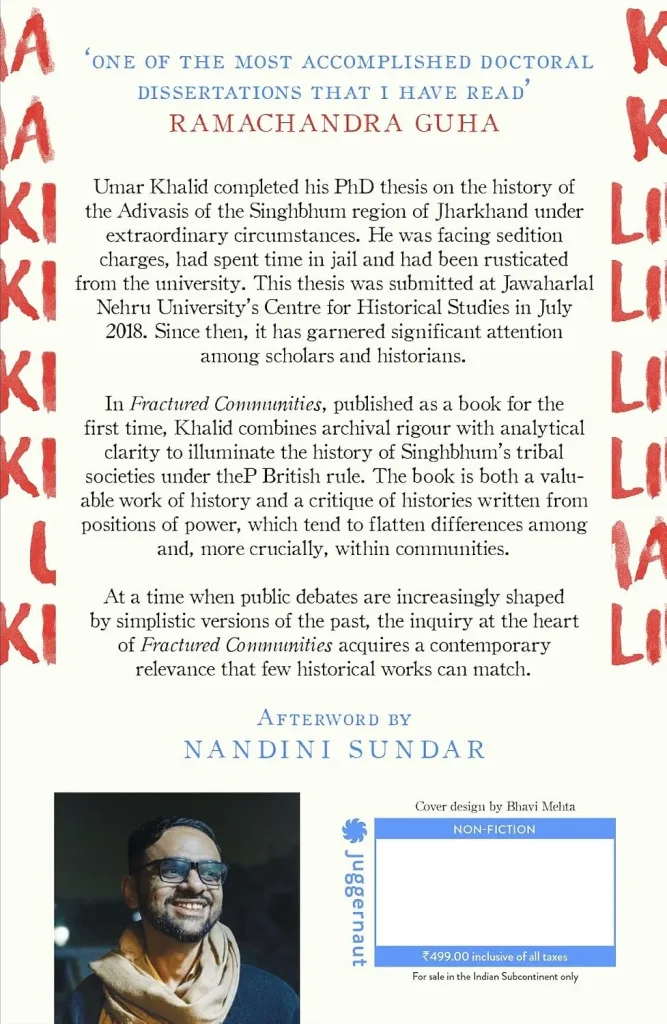
Fractured Communities by Umar Khalid seeks to revisit one such history by examining the Adivasi societies of the Singhbhum region in present-day Jharkhand during British colonial rule. Adapted from his widely discussed doctoral dissertation, the book combines archival research with critical historical analysis to explore the social, political, and economic transformations experienced by tribal communities.
Rather than presenting Adivasi society as a single, uniform entity, the book argues that internal differences, changing identities, and local histories are essential to understanding the region’s past. Through this approach, Fractured Communities contributes not only to tribal history but also to broader debates on colonialism, historiography, and the writing of Indian history.
About the Book
Fractured Communities is a work of historical research examining the evolution of tribal societies in the Singhbhum region of Jharkhand under British colonial administration.
Based on Umar Khalid’s doctoral research at Jawaharlal Nehru University’s Centre for Historical Studies, the book investigates how colonial governance, administrative policies, economic interventions, and political change influenced Adivasi communities over time.
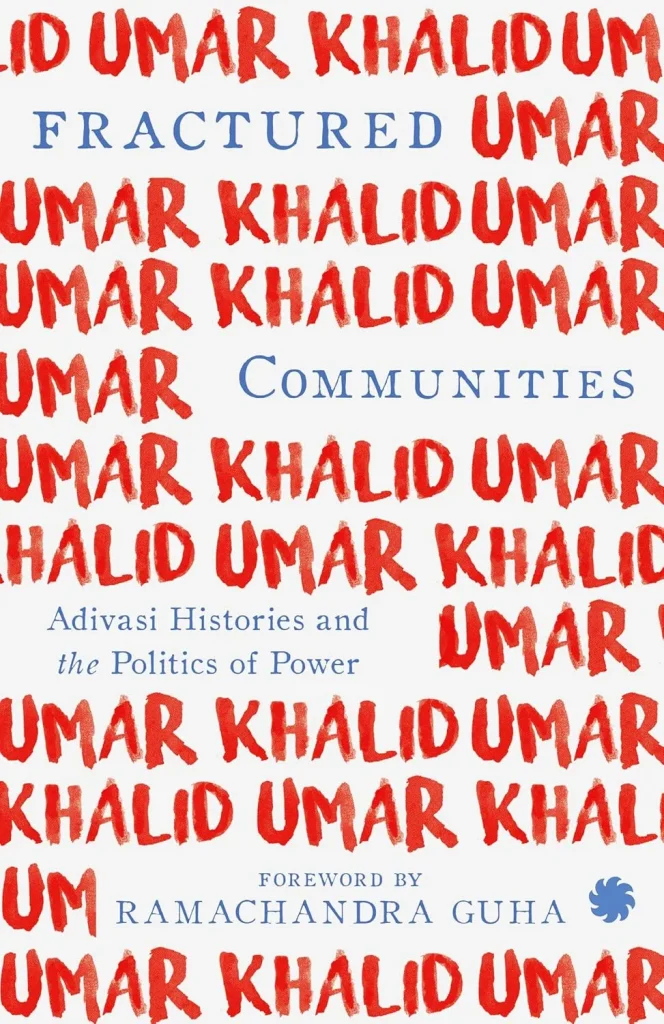
A central argument of the book is that colonial and postcolonial histories have often portrayed tribal societies as homogeneous groups, overlooking the diversity and internal complexities that shaped their social organization and historical development.
Drawing extensively from archival documents and historical records, the book explores themes including:
• colonial administration in Singhbhum
• Adivasi political and social structures
• tribal identities and community formation
• British governance and indigenous societies
• historiography and historical methodology
• power, representation, and historical memory
• regional history of Jharkhand
Rather than simply recounting historical events, the book examines how history itself is constructed and whose perspectives become dominant within historical narratives.
Read More: Blackbook of English Vocabulary 2026 Edition by Nikhil Gupta
Product Details
Publisher: Juggernaut
Publication Date: 27 June 2026
Language: English
Print Length / Pages: 400 pages
ISBN 10: 9353456363
ISBN 13: 9789353456368
About the Author
Umar Khalid is an activist, researcher, and public intellectual whose work has focused on democracy, constitutional rights, minority rights, and political history.
He pursued doctoral research in history at Jawaharlal Nehru University (JNU), specializing in the history of the Adivasi communities of the Singhbhum region. His doctoral dissertation attracted significant academic attention for its archival depth and historical analysis.
Alongside his academic work, Umar Khalid became widely known following the 2016 student movement at JNU, where he emerged as a prominent public voice on issues relating to freedom of expression, democratic participation, and constitutional values. He has also participated in campaigns addressing hate crimes and civil liberties.
Fractured Communities is the first publication of his doctoral research in book form, making his scholarly work accessible to a wider readership.
Review of Fractured Communities
As a newly published academic work, Fractured Communities has not yet accumulated a broad body of reader reviews. This assessment is therefore based on the book’s description, scholarly background, and stated research objectives rather than personal reading experience.
The book appears to make a significant contribution to the study of Adivasi history by challenging simplified understandings of tribal communities. Instead of treating indigenous societies as socially uniform, Umar Khalid’s research seems to emphasize the diversity, complexity, and historical evolution of communities within Singhbhum.
One of the most notable strengths suggested by the book’s description is its reliance on archival research. Historical studies grounded in primary sources often provide valuable insights into regional histories that remain underrepresented in mainstream narratives, and this work appears to follow that tradition.
The book also seems to engage critically with historiography itself. Rather than only documenting historical developments, it asks how history is written, whose voices become central, and how power shapes historical interpretation. This broader analytical perspective may appeal to readers interested in both history and historical methodology.
Its focus on colonial administration and indigenous societies also makes the book relevant beyond regional history. Questions concerning identity, governance, representation, and state formation continue to influence discussions within Indian history, anthropology, sociology, and political studies.
Given its origin as a doctoral dissertation, readers should expect a research-oriented work supported by historical evidence rather than a popular narrative history. The writing is likely to be analytical and scholarly, making it especially valuable for students, researchers, and readers interested in modern Indian history.
Overall, Fractured Communities appears to be a carefully researched historical study that contributes to contemporary scholarship by offering a nuanced examination of tribal societies and the ways historical narratives are constructed.
Why Read Fractured Communities
- Examines the history of the Singhbhum Adivasi communities through archival research
- Challenges simplified narratives about tribal societies
- Explores colonial governance and indigenous political structures
- Contributes to debates on historiography and historical methodology
- Offers insights into regional history often overlooked in mainstream scholarship
- Suitable for readers interested in Indian history, tribal studies, and colonial history
- Based on an academically recognized doctoral dissertation
Conclusion
Fractured Communities by Umar Khalid presents a detailed historical examination of the Singhbhum region and its Adivasi communities during British rule. By combining extensive archival research with critical historical analysis, the book seeks to recover complexities that are often absent from conventional historical narratives.
Its emphasis on diversity within communities, the politics of historical writing, and the relationship between colonial power and indigenous societies makes it relevant to readers interested in history, anthropology, political studies, and South Asian scholarship.
For those seeking a research-based exploration of tribal history and historiography, Fractured Communities appears to offer a thoughtful and substantial contribution.
Read More: KVS/NVS Interview Master Guide by Rohit Vaidwan
FAQ on Fractured Communities
What is Fractured Communities about?
The book examines the history of the Adivasi communities of the Singhbhum region under British colonial rule and explores how historical narratives about these communities have been constructed.
Who should read this book?
It is suitable for students, researchers, historians, and readers interested in Indian history, tribal studies, colonial history, and historiography.
Is Fractured Communities fiction or non-fiction?
It is a non-fiction academic history book based on doctoral research.
What themes does the book explore?
The book discusses colonial governance, Adivasi history, historiography, indigenous societies, regional history, and historical representation.
Is the book written for general readers or academics?
Although based on doctoral research, the published edition is intended to make the scholarship accessible to a wider audience while retaining its analytical depth.
Is there a Fractured Communities PDF download available?
Some websites may claim to offer a free PDF version of the book. However, downloading copyrighted material from unauthorized sources may violate copyright laws. Readers are encouraged to purchase the official edition from authorized sellers.